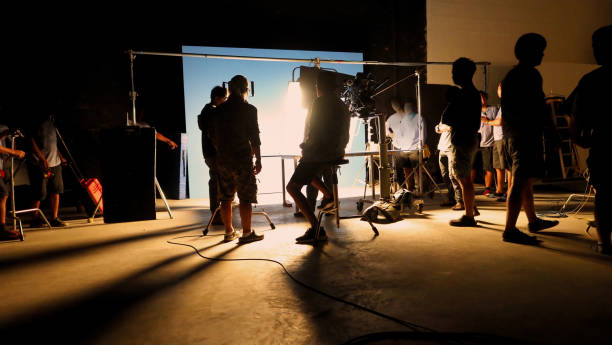
Bringing Big-Screen Soul to Tiny Screens: How Veteran Film Teams Are Rethinking Translation for Short Dramas
Veteran film crews have spent years perfecting the delicate art of making audiences feel something—the sting of betrayal in a close-up, the slow burn of tension before a revelation, the way a single well-timed line can shift everything. Then they step into the whirlwind of vertical short dramas, those relentless 60-to-90-second episodes that demand viewers stay hooked or swipe away forever. The pace is brutal, the budgets often razor-thin, and suddenly the old instincts for depth and nuance slam up against an unforgiving reality: how do you keep that cinematic emotional punch without blowing the production schedule or the bottom line?
The market doesn't wait for anyone to figure it out. China's short drama sector ballooned from around $500 million in 2021 to $7 billion by 2024, with forecasts showing it overtaking the entire domestic box office in 2025. Outside China, the space hit $1.4 billion in 2024 and is racing toward $9.5 billion by 2030 at roughly 28% annual growth, powered by subscriptions and in-app purchases that reward content people actually finish and come back for. Apps like ReelShort and DramaBox have turned bite-sized melodrama into serious business, but the ones that truly travel aren't just fast—they feel alive in every market.
For teams rooted in traditional filmmaking, the localization bottleneck hits hard. Straight translations often strip away the very things that made the original scene work: the rhythm of the dialogue, the cultural undercurrents, the raw emotional charge that makes a character’s outburst land like a slap. In vertical format, where every second counts and the frame is narrow, even small mismatches in timing or tone can kill momentum. Viewers sense when something feels off, even if they can't quite name it, and they scroll.
What separates the forgettable from the addictive is a kind of downscaled cinematic intelligence—treating localization not as a mechanical conversion but as an extension of the directing and editing process. Experienced crews intuitively get this. They've lived through countless post-production sessions where every syllable matters. Applied to short dramas, it means subtitles that breathe with the performance instead of fighting it, dubbing that captures the intensity without sounding like a bad soap opera overdub, and adaptations that respect the story's heart while making it feel native to new ears.
You see the difference in how successful projects handle voice and text. Subtitling done right stays crisp and readable on a phone held vertically—short, punchy lines that echo the original cadence without cluttering the screen. When dubbing enters the picture, it's approached more like ADR for a feature: voice actors who perform the emotion, not just recite words, matching the highs and lows that make these stories so compulsively watchable. The best work doesn't flatten cultural specifics; it finds equivalent sparks that resonate locally—whether that's adjusting the weight of family conflict for one audience or sharpening the revenge payoff for another—without rewriting the entire script from scratch.
This isn't about luxury spending. It's about smarter efficiency. Film teams already know how to run tight post-production pipelines. Layer in professional linguists who understand screen storytelling, combine it with precise transcription and timing tools, and you suddenly get higher retention and better conversion rates without doubling costs. Poor localization wastes everything that came before—the strong hooks, the cliffhangers, the escalating drama—because the audience never fully connects.
There's a quiet satisfaction in watching it click. A scene that felt electric in the source language suddenly lands with the same force in Spanish, Arabic, or Indonesian. The betrayal still hurts. The redemption still lifts. That moment is what keeps crews motivated as they pivot from longer-form work into this high-volume arena. Traditional talent brings something precious here: an ingrained respect for narrative rhythm and character truth that pure speed-focused production often overlooks.
Platforms are noticing. Some are blending imported Chinese hits with careful adaptation, while others experiment with local casts and hybrid approaches, especially in markets like the US, Southeast Asia, and Latin America. The shared lesson emerging is that treating localization as an afterthought limits how far a story can go. When it's handled with the same care given to lighting or sound design, short dramas stop feeling like cheap content and start carrying that elusive movie-like pull—even on a phone screen in portrait mode.
Teams making this transition don't need to reinvent their entire skill set. They need partners who speak the language of both cinema and rapid digital delivery, who can deliver subtitles or voice work that enhance rather than dilute the original vision.
Artlangs Translation has been quietly supporting exactly these kinds of shifts for more than 20 years. Specializing in video localization, short drama subtitling, game localization, multilingual audiobook narration, and precise data annotation and transcription, the company works with a network of over 20,000 professional translators and linguists covering more than 230 languages. They've built a track record on projects that demand both creative sensitivity and operational discipline—helping stories cross borders while preserving what made them compelling in the first place.
In a space where speed and volume rule, getting the emotional texture right still makes all the difference. The right localization doesn't just open new markets. It lets the original spark travel intact, turning fleeting scrolls into something that lingers a little longer.